
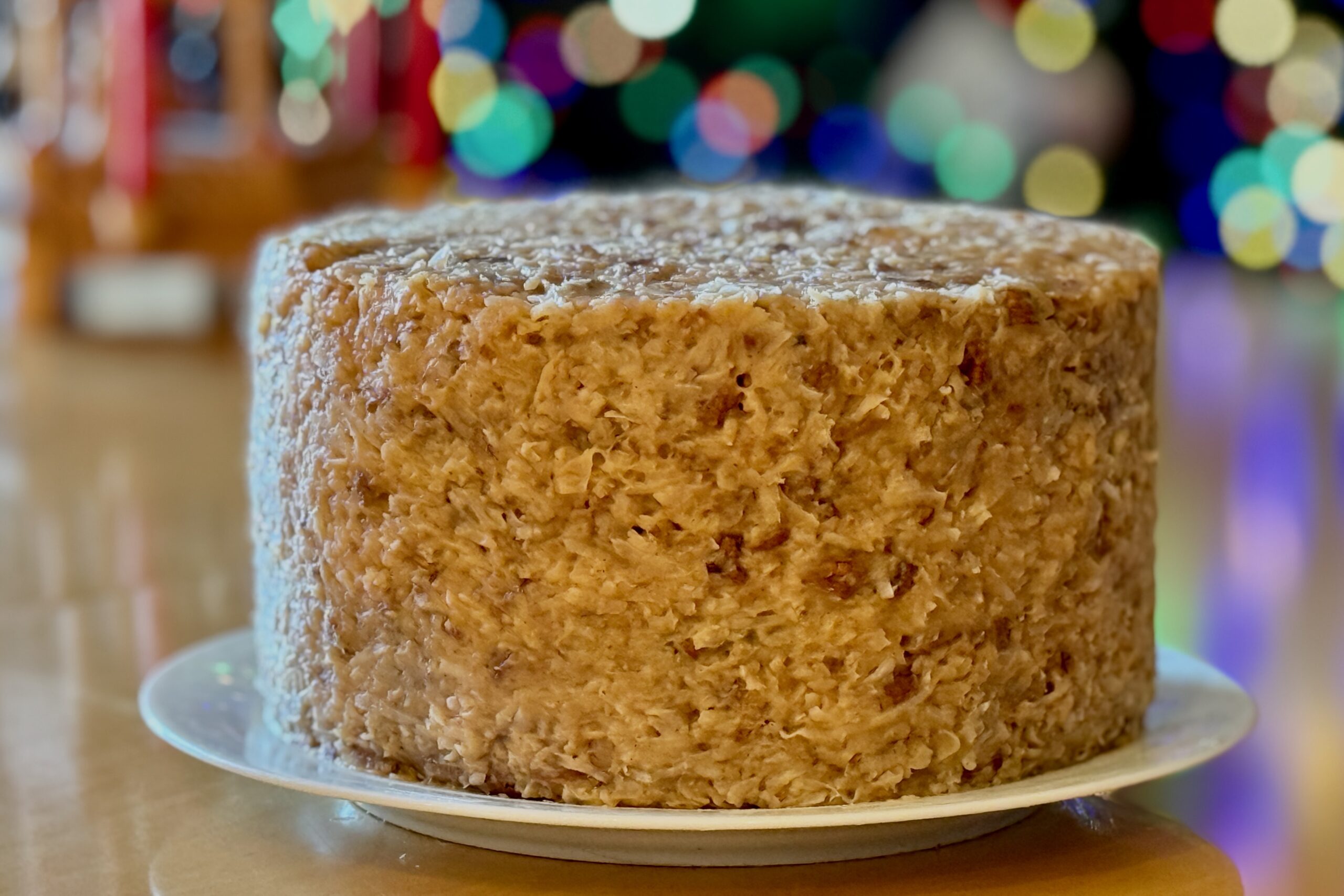
Every year on my wife’s birthday, there’s only one request — German chocolate cake. It’s become one of our family traditions, the kind of ritual you never change because it carries as much sentiment as flavor. But over time I also realized that while boxed mixes make the process easy, they often fall short of the tall layers, defined slices, and deep chocolate-and-coconut flavor we’ve come to expect. So this version became the answer: a handful of smart upgrades that turn a simple mix into something closer scratch-made, with richer flavor, a sturdier crumb, and bakery-worthy presentation. The layers bake up taller and slice beautifully, the frosting wraps the cake without slipping, and the whole thing feels celebratory without adding hours of prep. It’s the shortcut I make every year for my wife, and the version that finally gives us the flavor we love with the structure a three-layer cake needs.
Ingredients
Cake Layers
- 1 boxed German chocolate cake mix (prefer one that calls for milk; if not, substitute whole milk for the water)
- 1 cup (240 ml) whole milk (use 2–3 tbsp less than the package amount if milk is listed)
- 1 cup (225 g) melted butter plus 2 tbsp (28 g) extra
- 4–5 large eggs (two more than the box calls for; 4 for softer crumb, 5 for maximum stability)
- ½ cup (60 g) all-purpose flour
- 1 tbsp (8 g) cornstarch
- ½ tsp baking powder
- 1 tbsp Dutch-process cocoa powder
- ½ tsp instant espresso powder (enhances chocolate depth without adding coffee flavor)
- 1 tsp powdered gelatin, bloomed in 1 tbsp warm water
- 2 tbsp (30 g) sour cream or Greek yogurt
Coconut–Pecan Frosting
- 8 egg yolks
- 2 cans (each 12 oz / 354 ml) evaporated milk
- 3 cups (600 g) sugar
- 1½ cups (340 g / 3 sticks) butter
- 5⅓ cups (about 400 g) unsweetened shredded coconut (sweetened coconut also works with no measurement changes; frosting will simply be sweeter)
- 3 cups (300 g) chopped pecans
- 2 tbsp finely ground pecans
- ½ tsp table salt
- 1 tbsp (15 ml) vanilla extract
Directions
Prepare the Cake Layers
Bloom the gelatin by sprinkling it over 1 tbsp warm water in a small bowl. Let stand 5 minutes to fully hydrate. If the gelatin has set very firmly, gently warm it in the microwave for a few seconds until fluid before adding to the batter.
Preheat the oven to 320°F (160°C). Grease three 8-inch round cake pans lightly and dust with flour, then line the bottoms with parchment rounds for best release and to help prevent overbrowning on the base.
In a medium bowl, whisk together the cake mix, all-purpose flour, cornstarch, baking powder, Dutch-process cocoa powder, and instant espresso powder until evenly combined.
In a separate large bowl, whisk together the melted butter, eggs, milk, bloomed (and fluid) gelatin, and sour cream or Greek yogurt until smooth.
Add the dry ingredients to the wet ingredients and mix just until incorporated. Avoid overbeating to keep the crumb tender.
Divide the batter evenly among the three prepared pans, smoothing the tops.
Bake for about 24–30 minutes, or until the tops spring back lightly when touched, a toothpick inserted in the center comes out with moist crumbs (not wet batter), and the internal temperature in the center of each layer registers around 195°F (90°C) for the best balance of structure and moisture.
Cool the cakes in the pans for 10 minutes, then turn out onto wire racks to cool completely. For the cleanest slices, wrap and chill the cooled layers before assembly.
Make the Frosting
In a large saucepan, whisk together the egg yolks and evaporated milk until smooth and well combined.
Add the sugar and butter to the pan.
Cook over medium heat, stirring constantly, until the mixture reaches a gentle simmer. Once simmering, continue to cook for about 12 minutes, stirring frequently to prevent scorching and to develop a thicker, more stable frosting.
Remove the pan from the heat and stir in the salt first, making sure it dissolves fully in the warm mixture.
Add the vanilla extract and stir until fully incorporated.
Stir in the chopped pecans, finely ground pecans, and shredded coconut until evenly distributed.
Allow the frosting to cool completely; it will thicken significantly as it cools and will be much easier to spread on the cake.
Assemble the Cake
If needed, level the chilled cake layers using a serrated knife so they stack evenly.
Place the first layer on a serving plate. Spread a very thin “seal coat” of frosting over the top to trap crumbs, then chill briefly. Follow with a more generous layer of frosting for the filling.
Repeat with the second layer: add the layer, apply a thin seal coat, chill briefly, then spread on a full layer of frosting.
Place the third layer on top and apply a thin coat of frosting over the top and sides to lock in crumbs. Chill briefly again, then finish with a final, even layer of frosting over the top and sides. The extended cook time and finely ground pecans help the frosting cling well to the sides.
Chill the assembled cake for at least 2 hours (or overnight) before slicing for the cleanest, bakery-style cuts.
Notes
Preparation
- Choose a German chocolate cake mix that calls for milk when possible. If your mix uses water, substitute whole milk and reduce the amount slightly (about 2–3 tbsp less than the listed water volume).
- The added Dutch-process cocoa and espresso powder deepen the chocolate flavor without making the cake taste like coffee, helping the chocolate stand up to the rich coconut–pecan frosting.
- Using 4 eggs will give a slightly softer crumb, while using 5 eggs increases structure and height, which is ideal for very clean slices and tall layers.
- Fully blooming the gelatin and incorporating it with the wet ingredients strengthens the slice without making the cake dense or rubbery. If the gelatin sets too firmly, gently warm it until fluid before whisking it into the wet mixture.
- This cake was tested at a higher altitude using dark metal pans and a baking temperature of 320°F (160°C), with doneness judged by the spring of the cake, a clean toothpick with moist crumbs, and an internal temperature around 195°F (90°C) in the center of each layer.
- Frosting distribution: For evenly layered, bakery-style assembly, divide the frosting into four equal portions. Use about 25% between the first and second layers, 25% between the second and third layers, 25% on top of the cake, and the remaining 25% for the sides.
Serving Suggestions
- For the cleanest, restaurant-style slices, cut the cake while it is well chilled using a thin, sharp knife dipped in hot water and wiped dry between cuts.
- Let individual slices rest at room temperature for 10–15 minutes before serving so the crumb and frosting soften slightly and the flavors bloom.
- This cake pairs nicely with lightly sweetened vanilla or coconut ice cream, or with a dollop of softly whipped cream to balance the richness.
Make-Ahead & Storage
- Cake layers can be baked, cooled, wrapped tightly, and refrigerated for up to 2 days or frozen for up to 1 month before assembly.
- The coconut–pecan frosting can be made up to 2–3 days in advance and stored in an airtight container in the refrigerator. Bring it to a cool room temperature and stir until spreadable before using.
- The fully assembled cake should be stored covered in the refrigerator and is best enjoyed within 3–4 days.
- Extra frosting can be refrigerated for up to 1 week or frozen for longer storage; it works well as a topping for brownies, cupcakes, or ice cream.
Leave a Reply
You must be logged in to post a comment.