
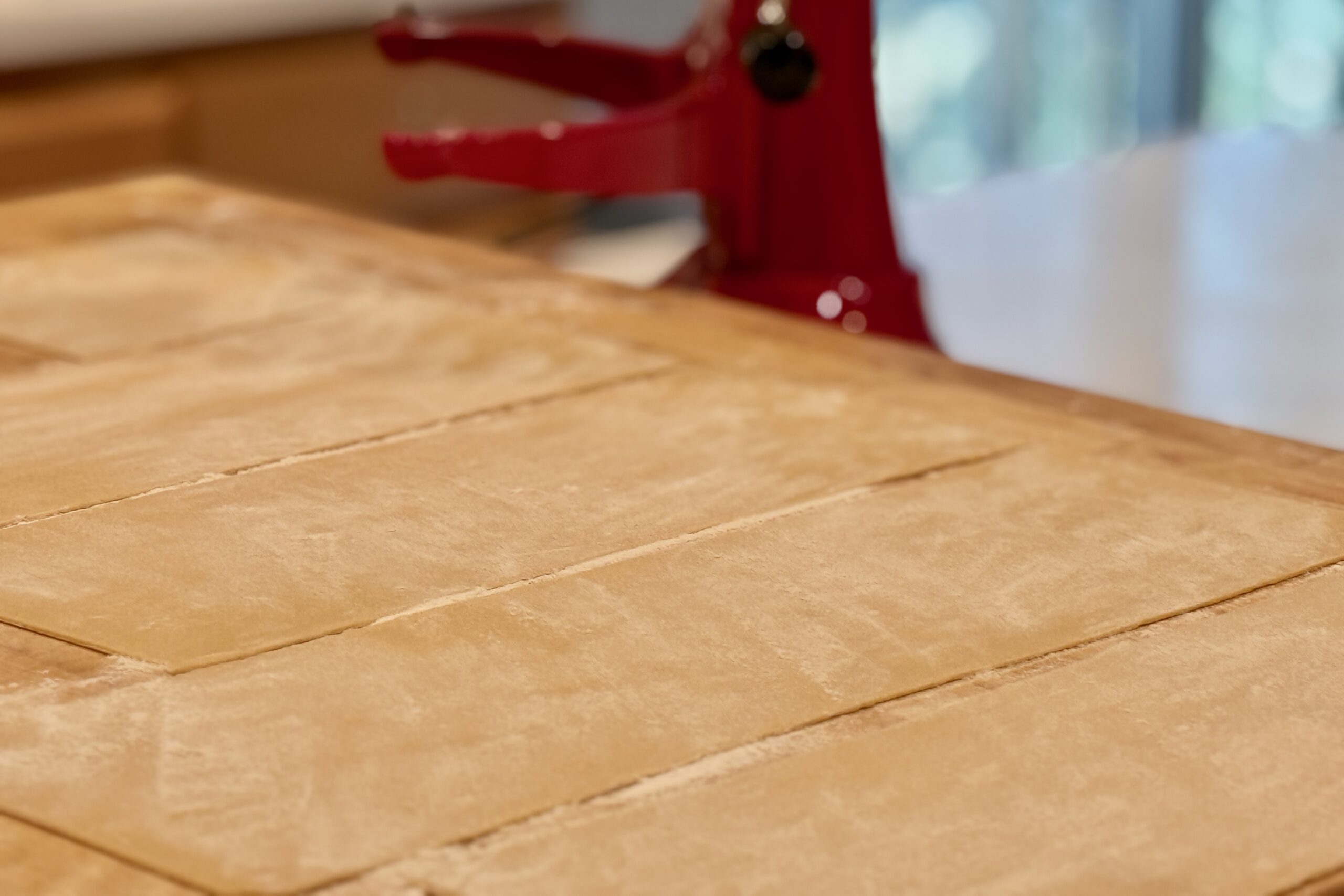
These fresh lasagna sheets are designed for structure, not just tenderness—giving you distinct, satisfying layers that hold their shape through baking. A blend of all-purpose flour and semolina adds just enough bite, while a slightly firmer dough ensures the pasta doesn’t disappear into the sauce. Rolled a bit thicker than traditional recommendations, this version creates a hearty, rustic lasagna with beautifully defined layers in every slice—perfect for dishes like our favorite recipe for Grandma’s Lasagna.
Ingredients
- 365 g all-purpose flour
- 90 g semolina flour
- ½ tsp table salt
- 4–5 large eggs (target 240–250 g without shells)
- 1 tbsp water, if needed
Directions
Mix the Dough:
Add the all-purpose flour, semolina flour, and salt to the bowl of a stand mixer fitted with the paddle attachment. Mix on speed 2 just to combine.
Add 4 eggs, one at a time, mixing briefly between additions. The mixture should resemble coarse crumbs. If the dough does not begin to come together, add part or all of the remaining egg as needed. Add up to 1 tbsp water only if necessary to bring the dough together into a firm, slightly dry mass.
Knead:
Switch to the dough hook and knead on speed 2 for 2–3 minutes, until the dough becomes smooth and cohesive. It should feel firm but pliable, not sticky.
Rest:
Wrap the dough tightly in plastic wrap and let rest at room temperature for at least 30 minutes. For best results, refrigerate up to overnight, then allow to come to room temperature before rolling.
Roll the Sheets:
Divide the dough into 4 portions. Working with one piece at a time, flatten slightly and run through a pasta roller, folding and passing through the widest setting several times until smooth.
Gradually reduce the thickness setting until reaching setting #3 or #4 . Cut sheets to fit your baking dish as needed.
Prepare for Use:
Lay sheets on a lightly floured surface and allow to rest for 10–20 minutes before using. This slight drying improves texture and handling.
Cook (Optional):
These sheets can be used directly in lasagna without boiling, especially when using a well-hydrated sauce.
If parboiling is preferred, cook in well-salted boiling water for 2–3 minutes, then transfer to cold water and drain before layering.
Notes
Preparation
- For best consistency, weigh the eggs. Aim for 240–250 g total egg weight.
- The dough should feel slightly firmer than typical pasta dough—this helps it hold structure during baking.
- Lightly flour sheets as needed to prevent sticking, but avoid excess flour which can dry out the layers.
Serving Suggestions
- Use with a rich meat sauce and béchamel for classic lasagna.
- Pairs well with vegetable-forward lasagnas, including spinach and mushroom or roasted vegetable variations.
Variations
- For a more traditional, delicate lasagna, roll sheets to setting #4 or #5.
- For a richer dough, replace 1 whole egg with 2 egg yolks.
- For a softer texture, reduce semolina slightly and increase all-purpose flour.
Make-Ahead & Storage
- Dough can be refrigerated for up to 24 hours before rolling.
- Rolled sheets can be lightly floured, layered between parchment, and refrigerated for up to 1 day.
- For longer storage, freeze sheets flat and transfer to a sealed bag once solid. Cook from frozen or thaw before use.
Leave a Reply
You must be logged in to post a comment.